
Rivers
How Water Temperature Affects Trout Fishing
Trout are coldwater fish, but species, life stage, and local water all matter. Learn what temperature changes in a stream, what it does not prove, and how StrikeTracks presents thermal context.
StrikeTracks Editorial Team3 min read
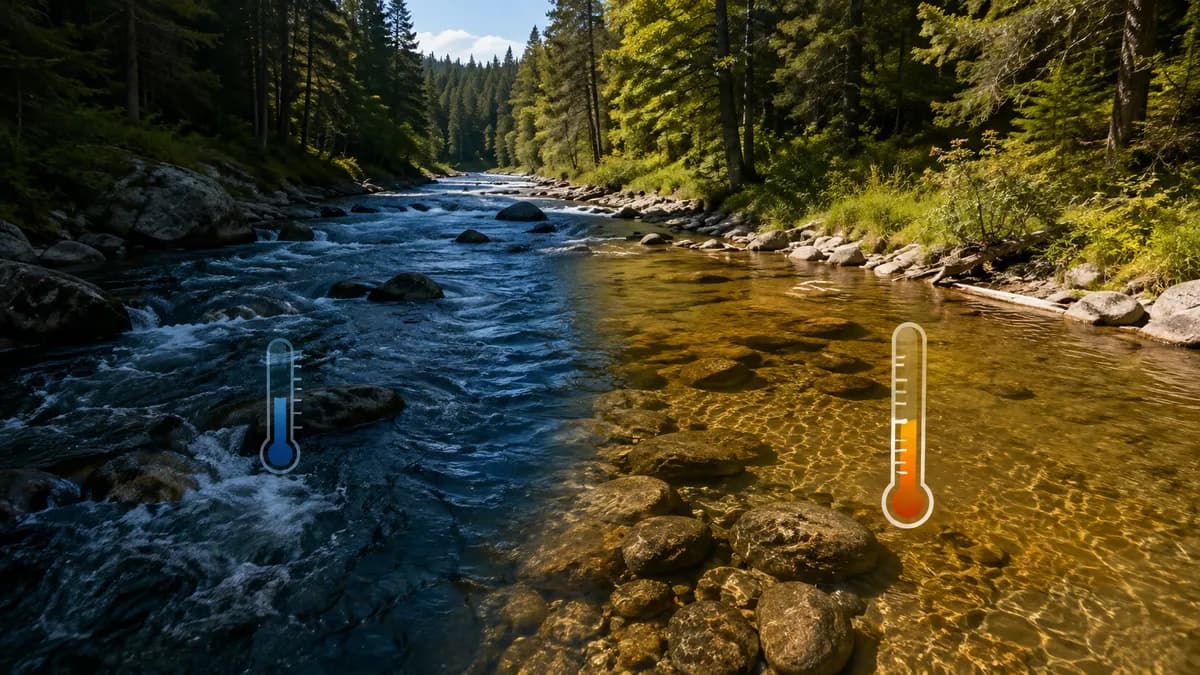
Water temperature is one of the few river observations that connects physics to fish biology in a way anglers can actually use. Trout are coldwater fishes. As water warms, their oxygen environment, metabolism, and stress responses change. That does not mean a single thermometer reading tells you whether they will eat, or whether you should keep a fish.
Temperature is local, not a national trout rule
Brook trout, brown trout, and rainbow trout do not share one thermal identity. Federal water-quality literature treats temperature criteria as species- and life-stage-specific. Example tables used in EPA temperature factsheets list different growth and short-term maxima for rainbow trout than for warmwater species such as largemouth bass. Those tables are examples of how criteria are built. They are not a pocket chart for every U.S. river.
USGS laboratory and field work on brook trout has found physiological stress responses clustering near about 21 °C (roughly 70 °F), in the same neighborhood as proposed ecological thermal limits for the species. Other reviews of salmonids report lethal temperatures that vary with acclimation, age, and test method. The practical lesson is narrower than a slogan: warming water can move trout from preferred conditions into stress long before a laboratory lethal number, and field populations often show effects below the most extreme lab limits.
Air temperature is not water temperature
A hot afternoon can coincide with still-cool spring influence, canyon shade, or a tailwater. A mild day can sit on a wide, shallow river that has already warmed. StrikeTracks river logic is explicit that air observations must not be used to invent discharge, stage, or wading safety, and they are a poor substitute for measured water temperature. If a page does not have a qualifying water-temperature observation, it should not pretend that the forecast high filled the gap.
What warming water changes for anglers
- Fish may use colder tributaries, springs, deeper runs, or shade when mainstem temperatures rise.
- Handling time, air exposure, and fight duration matter more as water warms. A fish that looks “fine” in the net can still be thermally stressed.
- Some states and local managers publish thermal fishing restrictions or refuge guidance in summer. Those rules are legal and conservation tools, not StrikeTracks ratings. Check the agency that actually regulates the water you will fish.
- Low flow and high sun often travel together. Temperature and discharge are related in the environment even when they are separate fields on a page.
How StrikeTracks uses temperature
Where a river has a qualifying water-temperature source, StrikeTracks can show it among current readings and use thermal context inside the destination’s accepted evaluator. Those product thresholds are destination- and policy-specific. They are not republished here as universal biology, and they are not a claim that every trout river in the catalog uses the same cutoffs.
Where temperature is missing, StrikeTracks should leave it missing or qualify what is shown. Estimated Conditions, when used, are a lower-confidence evidence class — not a modeled thermometer that equals a gage probe. See Monitoring-Backed vs. Estimated Fishing Conditions.
A favorable trout rating still does not mean the fish are feeding, that harvest is appropriate, or that wading is safe. It is decision support for environmental suitability under the destination’s contract. If summer water is warm, the most useful extra step is often conservation: shorter fights, wet hands, and leaving fish in cold water rather than proving a point on the bank.
Related Fishing Insights
- How River Flow Affects Fishing Conditions
Flow changes how a river fishes, how it looks, and how safely you can enter it. This article explains discharge in angler terms and how StrikeTracks uses destination-specific flow context.
- What Makes a Fishing Window “Good”?
A good window is a planning judgment under uncertainty — not a promise that fish will eat. StrikeTracks ratings and Should I Go are decision support built from destination-specific evidence.
- Monitoring-Backed vs. Estimated Fishing Conditions: What’s the Difference?
StrikeTracks uses two different evidence classes for fishing conditions. Here is what each one means, why they are not interchangeable, and how to read them honestly.