
Lakes
Understanding Lake Turnover and Seasonal Fishing Conditions
Many lakes stratify in summer and mix when surface and deep water approach the same density. Turnover is real physics — not a StrikeTracks rating, and not a rule that every pond “turns” on the same week.
StrikeTracks Editorial Team2 min read
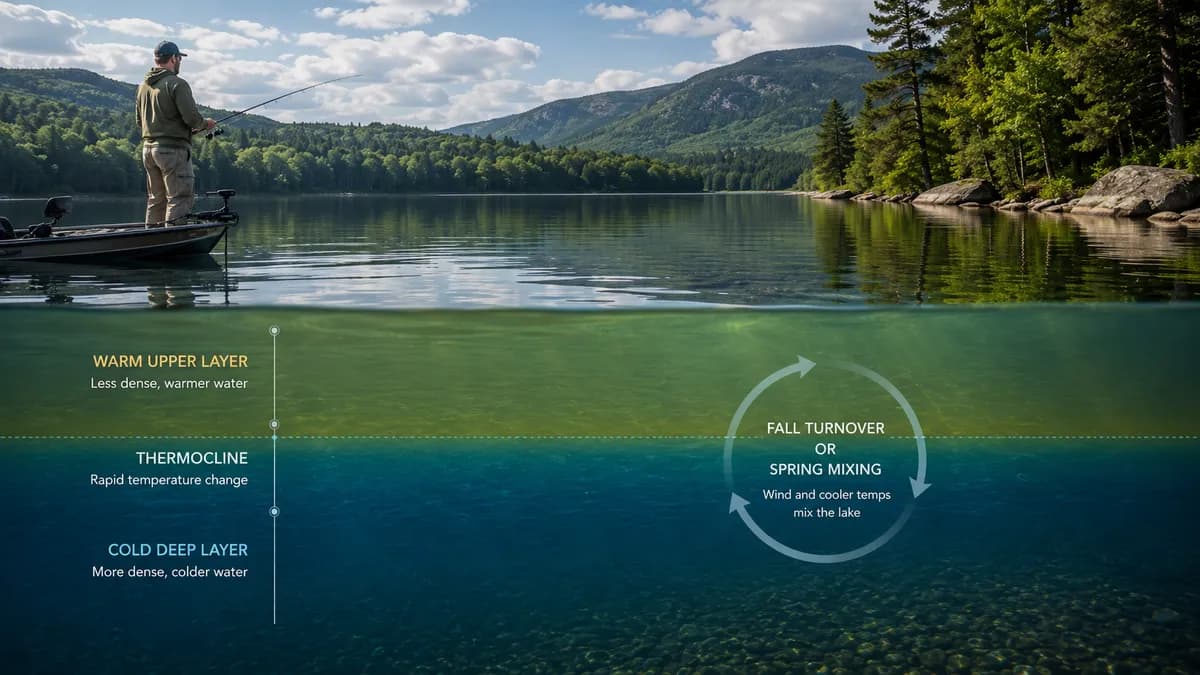
If you have swum in a stratified lake, you already know the physics: warm water on top, colder water below. USGS Water Science School material describes that pattern and the seasonal “turning” of layers when surface temperature and density change. Anglers call the mixing period turnover. It is a useful idea. It is also easy to over-apply to every impoundment on the map.
Stratification in plain language
In the warm season, solar heating and the fact that warmer water is less dense keep a lighter layer on top. Mixing between that layer and the colder, denser water below is limited. USGS notes that dissolved oxygen is tightly related to this temperature structure, which is why the deep water of a fertile, stratified lake can become a poor oxygen environment even when the surface looks fine.
As autumn cooling — or, in cold climates, spring warming after ice — brings surface temperature closer to the water below, density differences shrink. Wind can then mix a lake top to bottom. USGS is also clear that warm climates may never cool the surface enough for the same winter turning pattern you see in a Minnesota temperature-profile illustration. Mixing regime depends on climate, depth, and wind. USGS-linked research on ponds and shallow lakes finds that not all small waterbodies mix continuously; some stratify for long stretches of summer.
What turnover is not
- It is not a calendar holiday. “The third week of October” is not a national mixing date.
- It is not proof that fish “shut off” everywhere. Some fisheries get harder to pattern during mixing and stain; others stay fishable. Local water decides.
- It is not something StrikeTracks currently publishes as a named destination rating or a guaranteed seasonal badge. Lake pages present the observations and evidence class they are configured to use — weather, level, temperature where they qualify — not a turnover forecast.
How to use the idea as an angler
Treat turnover as a hypothesis about water-column structure, then look for local signs: a sudden stain or “lake stink” in some fertile basins, a breakdown of a sharp temperature break you felt earlier in the summer, or simply a season and climate where mixing is expected. Pair that with How Weather Affects Lake Fishing Conditions so you do not confuse a cold front with a fully mixed water column.
On StrikeTracks, read the lake’s evidence class first. Monitoring-backed and Estimated Conditions are not interchangeable, and Estimated is not offered on every lake. A Fair rating during autumn is still decision support, not a statement that turnover is complete or that fish have “settled.” See Monitoring-Backed vs. Estimated Fishing Conditions and What Makes a Fishing Window “Good”?. If you need depth-specific temperature, you still need a measurement or a local source — not a slogan.
Related Fishing Insights
- How Weather Affects Lake Fishing Conditions
Air temperature, wind, clouds, and rain change a lake’s surface quickly. They do not replace water-column physics, and they do not make every lake equally observable.
- What Makes a Fishing Window “Good”?
A good window is a planning judgment under uncertainty — not a promise that fish will eat. StrikeTracks ratings and Should I Go are decision support built from destination-specific evidence.
- Monitoring-Backed vs. Estimated Fishing Conditions: What’s the Difference?
StrikeTracks uses two different evidence classes for fishing conditions. Here is what each one means, why they are not interchangeable, and how to read them honestly.