
Conditions
Why StrikeTracks Shows Unavailable Instead of Inventing a Rating
Unavailable means insufficient evidence, not Poor fishing. Real river and lake examples show why StrikeTracks abstains rather than remapping a nearby station or guessing.
StrikeTracks Editorial Team2 min read
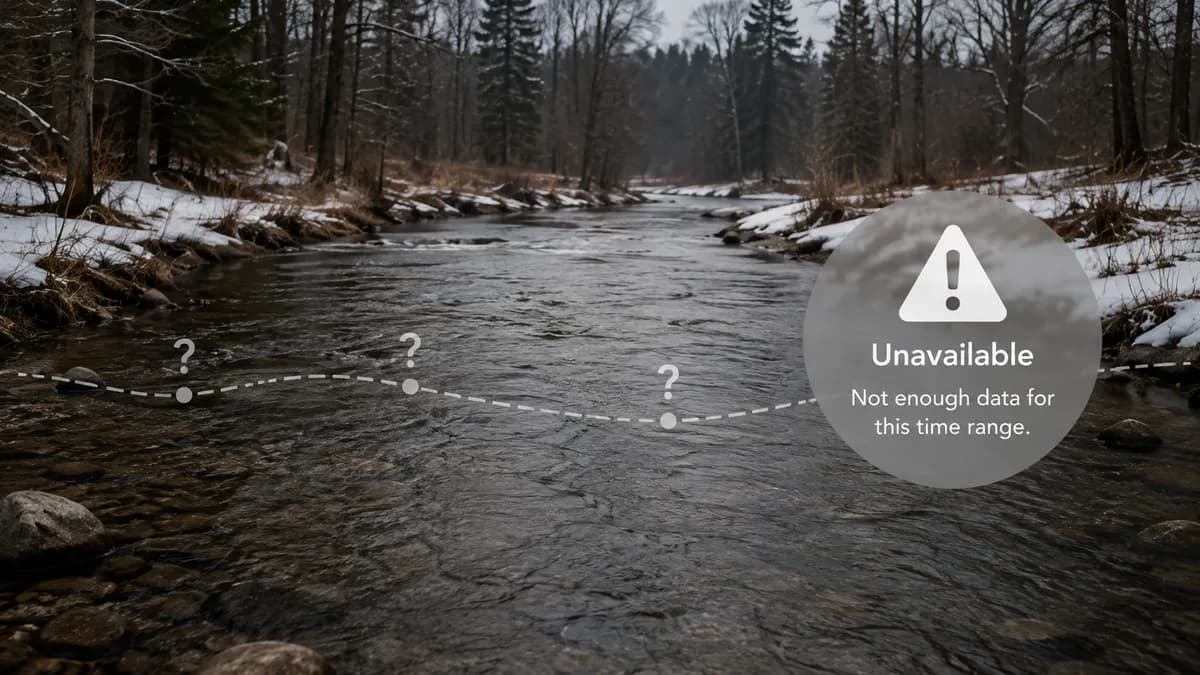
The honest product move, when evidence is insufficient, is to show Unavailable. Inventing a rating from a nearby creek, an old gage, or yesterday’s air temperature would look more complete and be more wrong. StrikeTracks treats abstention as a first-class result. Unavailable is not Poor. Poor is a rating. Unavailable is the refusal to rate.
Structural Unavailable at a real lake
Alum Creek Lake is a USACE / Alum Creek State Park reservoir in Delaware County, Ohio, and a flagship ODNR muskellunge water next to Columbus. StrikeTracks publishes complete static Fishery for that lake. Conditions stay Catalog-visible Unavailable because no same-lake live USGS water temperature (parameter 00010) exists. Alum Creek at Africa, USGS 03228805, is a downstream stream site. It is not this lake’s pool thermal. Remapping it would manufacture a monitoring-backed lake that the evidence does not support.
A limited-evidence river is a different shape of the same idea
McCloud River below McCloud Dam is a California wild-trout corridor. No live USGS streamgage is assigned. Historical USGS 11367500 is not used and is not resurrected. Nearby or unrelated stations are not substitutes. Weather-only Unavailable can still sit next to useful static fishery guidance. That is not Estimated Conditions. Estimated is a separate, labeled, lower-confidence class used only where an accepted estimated path exists.
Estimated versus Unavailable versus monitoring
Allegheny Reservoir near Warren shows the other honest lake pattern: USGS 03012520 provides live reservoir elevation, not live lake-surface temperature, and not the Kinzua outlet river. Elevation-only monitoring is not a license to invent thermal ratings. Burke Lake in Virginia is an ordinary inland lake without a same-lake USGS temperature station, where accepted MODEL-2 Estimated coverage can apply with disclosure. Three lakes, three classes: structural Unavailable, elevation-monitored without fake temperature, and Estimated where policy actually allows it.
None of those pages should be read as “bad fishing.” A muskie lake with Unavailable conditions can still be a complete planning destination if you use Fishery, access, and regulations — and you still verify the water yourself. Monitoring-Backed vs. Estimated Fishing Conditions is the class primer. Research & Methodology is the publisher contract.
Sources and methodology
These are the primary sources this article actually relies on. Linked agencies do not endorse StrikeTracks conclusions.
- U.S. Army Corps of Engineers — Alum Creek Lake — USACE recreation information for Alum Creek Lake. It does not create a same-lake USGS water-temperature station for StrikeTracks conditions.
- Ohio Department of Natural Resources — Wildlife — Ohio fishing regulations remain authoritative for Alum Creek Lake, including muskellunge and other inland species rules.
- California Department of Fish and Wildlife — inland trout waters — California wild-trout and inland fishing rules remain authoritative for McCloud River below McCloud Dam.
- USGS 03012520 — Allegheny Reservoir near Warren, PA — StrikeTracks uses this location for reservoir elevation (parameter 62615, NAVD88). It is not the Kinzua Dam outlet river, and it is not a substitute lake-surface temperature station.
- StrikeTracks Research & Methodology — Alum Creek Lake uses catalog publication policy static-value-structural-unavailable. McCloud River below McCloud Dam has no live USGS assignment; historical 11367500 is not resurrected. Allegheny Reservoir is elevation-monitored, not a silent temperature substitute. Unavailable is not Poor.
Related Fishing Insights
- Monitoring-Backed vs. Estimated Fishing Conditions: What’s the Difference?
StrikeTracks uses two different evidence classes for fishing conditions. Here is what each one means, why they are not interchangeable, and how to read them honestly.
- What StrikeTracks Confidence Actually Means
High, Medium, and Low confidence describe evidence quality — not how good the fishing is, and not whether you should wade. Here is how those public labels work, without a hidden scoring rubric.
- How to Use StrikeTracks to Plan a Fishing Trip
A practical walkthrough of Explore, destination pages, evidence classes, and trip guidance — without treating StrikeTracks as a guarantee of success or safe access.