
Rivers
Fishing After Rain: What River Anglers Should Check First
Rain can improve a river, ruin a river, or make it dangerous — sometimes all three on the same drainage. Check safety and the hydrograph before you tell yourself a story about the bite.
StrikeTracks Editorial Team2 min read
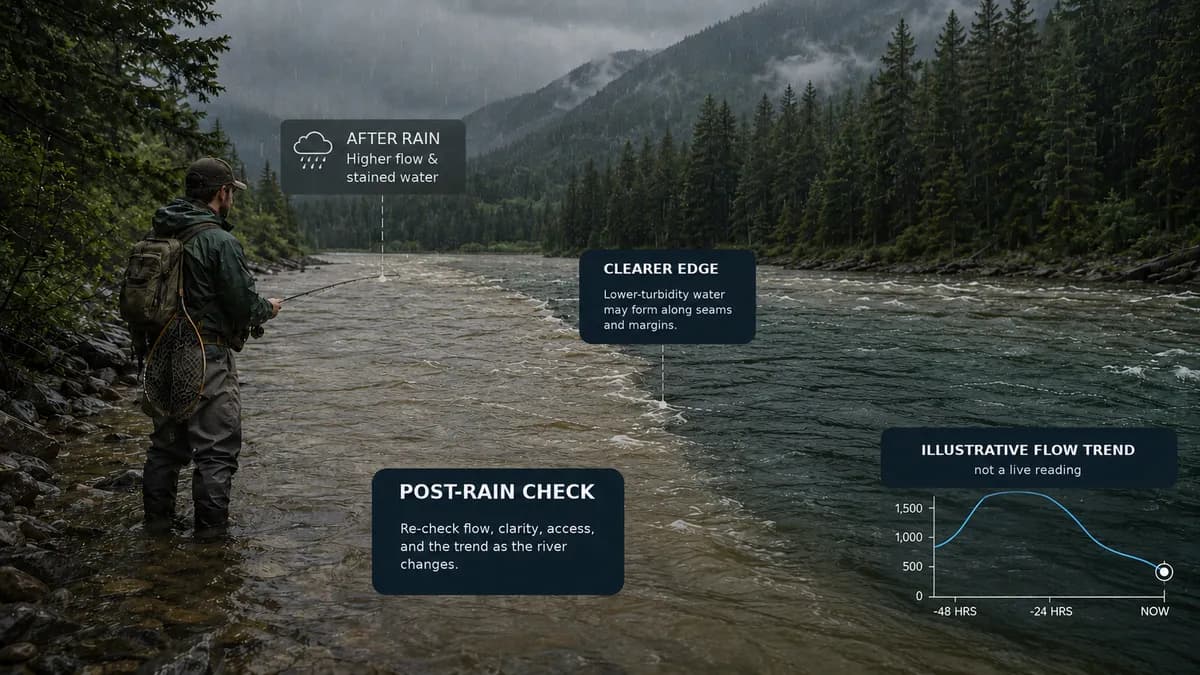
“Fish after a rain” is one of the oldest pieces of river advice, and one of the least specified. Rain can put food in the drift, stain water enough for a closer approach, or turn a wadable riffle into a debris-filled chute. The first job after a storm is not to pick a lure. It is to decide whether the river is still the river you thought you were driving to.
Check safety products before fishing folklore
The National Weather Service issues watches and warnings for flash flooding when rapid rises are possible. Those products exist because small drainages can respond in minutes to hours. If a flash-flood warning covers the basin, the fishing question is finished. USGS streamgages and, in some emergencies, rapid-deployment gages exist to observe rises — they are not an invitation to stand in rising water to “see if it’s fishable.”
Then read the hydrograph, not the parking-lot puddle
A wet trailhead means rain fell there. It does not tell you whether the pulse has arrived at the gage related to your reach, whether a tributary already peaked, or whether the river is still rising. USGS discharge is computed from stage using a site-specific rating. Look at the recent trace: rising, peaked, or falling. A falling river after a spike is a different fishing problem than a river that has not crested. How to Read a USGS Stream Gauge covers what the numbers are.
What rain can change in the fishing environment
- Discharge and current speed: more water, faster water, less room to wade. Fishing suitability and wading safety stay separate — Wading Conditions vs. Fishing Conditions.
- Clarity: runoff often carries sediment. Stain can help or hurt depending on the fishery; neither outcome is guaranteed.
- Temperature: summer rain can cool a surface layer or, in some storms, arrive warm. Do not assume a thunderstorm fixed a thermal problem.
- Debris and access: logs, muddy launches, closed gates. None of that appears as a CFS integer.
How StrikeTracks fits — and where it stops
If the river is Monitoring-backed, StrikeTracks can show qualifying flow and related observations after the sources refresh. That is still a snapshot. Estimated Conditions, where used, are lower confidence and do not become a live storm gage because it rained. StrikeTracks will not invent a universal “fish the drop” rule. Destination-specific flow context, when configured, is not a copy of another river’s folklore.
After rain, use this order: NWS flood products, then the hydrograph and any alerts on the destination page, then whether you can fish without entering unsafe current, then whether the environmental window is still interesting. How River Flow Affects Fishing Conditions is the flow primer. Ratings remain decision support. If the river is up and angry, go home. There will be another day.
Related Fishing Insights
- How River Flow Affects Fishing Conditions
Flow changes how a river fishes, how it looks, and how safely you can enter it. This article explains discharge in angler terms and how StrikeTracks uses destination-specific flow context.
- How to Read a USGS Stream Gauge for Fishing
USGS streamgages report water level and often compute discharge. Learn what gage height, flow, and temperature mean for trip planning — and what they never tell you by themselves.
- Wading Conditions vs. Fishing Conditions
A river can fish well and still be a poor idea to wade. StrikeTracks keeps fishing suitability and hydrologic or wading safety as separate questions — and so should you.