
Trip planning
How Fishery Targets Change What a “Good” Window Means
Environmental conditions are not the whole fishing decision. Trout on the Swift, bass on the Charles, and harbor-island stripers show how targets change planning without rewriting condition science.
StrikeTracks Editorial Team2 min read
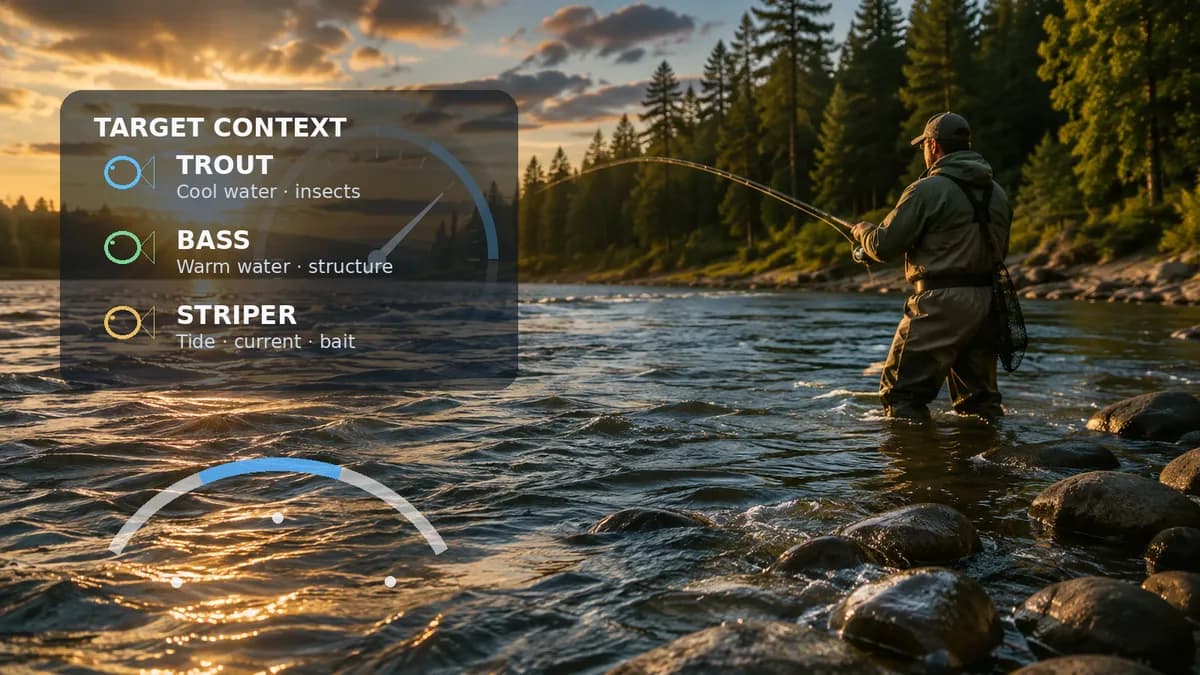
A “good” window on StrikeTracks is an environmental planning judgment under uncertainty. It is not automatically a good window for every fish in the catalog. Target context — what you came to catch, and whether that fish is even in season — sits beside the rating. It does not silently rewrite the rating. If you change the Fishing Target selector, you are changing planning context, not issuing a new law of hydrology.
Same state, two fisheries, two ideas of good
Swift River at West Ware is a cold Quabbin-release trout corridor. Rainbow and brown trout are primary. A useful environmental window still has to survive trout thermal caution and a small-channel flow band. Techniques on that page include dry flies, nymphing, and spinning. Hatch Match may apply as trout-water hatch coverage. “Good” here is trout-water good, not bass-water good.
Charles River at Waltham is a Greater Boston warmwater node on USGS 01104500. Largemouth and smallmouth bass are primary, with carp and yellow perch present. The record is the Waltham gage reach, not the tidal Basin. A discharge that looks ordinary for bass water would be a different story on the Swift. The Charles Good flow band is 50–200 cfs; the Swift’s is 30–80 cfs. Those numbers are not interchangeable, and neither is the fishery.
Coastal targets add seasonality the rating does not invent
Boston Harbor and Islands lists striped bass, bluefish, and tautog among its fishery targets, with seasonal windows on the coastal profile. A fair marine morning in January is not a striper window because the target is not in that seasonal story. The condition rating still has to be honest about tide, current, and wind. The target calendar does not get to mint a bite.
Rating versus planning
Canonical condition science answers: what does the evidence say about this water’s environment right now, under the destination contract? Fishery, Technique, Hatch, and seasonal targets answer: what are you trying to do, and is that even a plausible trip for this water? Mixing them into one secret score would hide both answers. What Makes a Fishing Window “Good”? keeps Go / Consider / Wait as trip language. How to Use StrikeTracks to Plan a Fishing Trip is the end-to-end walkthrough.
Always finish on the managing agency. MassWildlife rules for the Swift and the Charles are not the same as Massachusetts saltwater rules for Boston Harbor. StrikeTracks will not claim that picking a species in the UI changed the river.
Sources and methodology
These are the primary sources this article actually relies on. Linked agencies do not endorse StrikeTracks conclusions.
- USGS 01175500 — Swift River at West Ware, MA — The monitoring location assigned to StrikeTracks destination Swift River at West Ware. Use the station page for current and historical stage and discharge; this article does not invent a live reading.
- USGS 01104500 — Charles River at Waltham, MA — The monitoring location assigned to StrikeTracks destination Charles River at Waltham.
- MassWildlife — Massachusetts freshwater fishing regulations, stocking reports, and trout-water management are authoritative for Swift River at West Ware and Charles River at Waltham. Confirm current rules before you go.
- StrikeTracks Research & Methodology — Canonical condition ratings remain destination environmental evaluations. Fishery targets, Technique, Hatch, and seasonal windows are planning context. This article does not claim that selecting a target species rewrites accepted condition science.
Related Fishing Insights
- What Makes a Fishing Window “Good”?
A good window is a planning judgment under uncertainty — not a promise that fish will eat. StrikeTracks ratings and Should I Go are decision support built from destination-specific evidence.
- How to Use StrikeTracks to Plan a Fishing Trip
A practical walkthrough of Explore, destination pages, evidence classes, and trip guidance — without treating StrikeTracks as a guarantee of success or safe access.
- How Water Temperature Affects Trout Fishing
Trout are coldwater fish, but species, life stage, and local water all matter. Learn what temperature changes in a stream, what it does not prove, and how StrikeTracks presents thermal context.