
Conditions
Why Fishing Conditions Can Change So Quickly
Rivers rise on a delay, wind builds waves in hours, and tides turn on a clock. A morning snapshot is not a day-long guarantee — on StrikeTracks or on the water.
StrikeTracks Editorial Team2 min read
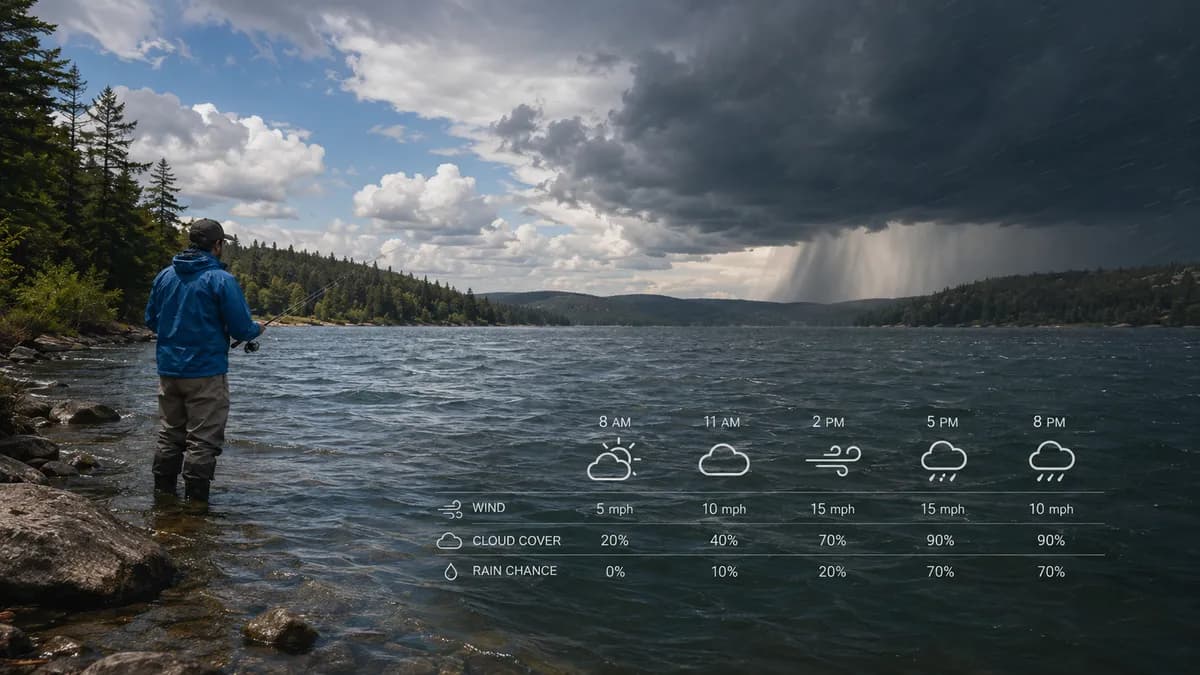
You can leave the house under a blue sky and find a different river by lunch. That is not StrikeTracks “being wrong.” Water and weather are processes. A destination page is a snapshot of the observations it is allowed to use at a point in time. If those inputs move, the fishing environment moves — sometimes faster than a drive.
Rivers: the hydrograph is a delay line
Rain on the parking lot is not the same as rain already in the channel. Runoff concentrates as it moves downstream. A tributary can blow while the mainstem gage you bookmarked is still quiet — or the gage can be rising while the sky over you is clear. USGS streamgages commonly transmit on the order of minutes, and more often in floods at some sites, but the water still has to travel. After storms, treat the recent trace as more important than a single “good” tick. Fishing After Rain is the checklist.
Regulated rivers add another clock: generation and gate changes can raise stage on a schedule that has nothing to do with the county forecast. StrikeTracks does not replace the dam operator’s notice. If a page shows operator or alert context, read it as a reason to re-check, not as a guarantee of the next hour.
Lakes and coast: wind and tide are short fuses
On lakes, a calm morning can become an unsafe afternoon when wind increases over a long fetch. On the coast, tidal current turns on a predictable astronomical cycle, while wind-driven seas and nontidal current can change the same inlet in a single watch. NOAA is explicit that current predictions omit wind, weather, and river flow at the surface. A “perfect” tide window can still be a poor boat day.
What changes quickly versus what does not
- Can move in hours: wind and waves, thunderstorms, tidal current around slack, some tailwater pulses, small-stream flashiness.
- Often moves on a lag: mainstem rise after widespread rain, reservoir level, seasonal lake mixing.
- Does not move because you refreshed a rating: regulations, the destination’s evidence class, or a missing sensor. Unavailable is still unavailable.
How to plan as if the morning is not the whole day
Use StrikeTracks to decide whether the trip is plausible, then keep a kill criterion: rising hydrograph, building seas, lightning, or a generation notice. A Fair or Good window is not a day pass. See What Makes a Fishing Window “Good”? and How River Flow Affects Fishing Conditions. Ratings remain decision support. If the water in front of you disagrees with the snapshot you left home with, believe the water.
Related Fishing Insights
- Fishing After Rain: What River Anglers Should Check First
Rain can improve a river, ruin a river, or make it dangerous — sometimes all three on the same drainage. Check safety and the hydrograph before you tell yourself a story about the bite.
- What Makes a Fishing Window “Good”?
A good window is a planning judgment under uncertainty — not a promise that fish will eat. StrikeTracks ratings and Should I Go are decision support built from destination-specific evidence.
- How River Flow Affects Fishing Conditions
Flow changes how a river fishes, how it looks, and how safely you can enter it. This article explains discharge in angler terms and how StrikeTracks uses destination-specific flow context.